Applications of Blockchain Technology in Plant Sciences: Opportunities, Challenges, and Future Directions
DOI:
https://doi.org/10.22034/JAPB.2025.175Keywords:
Blockchain Technology, Plant Sciences, Smart Contracts, Germplasm Authentication, Data Integrity, IoT-EnabledAbstract
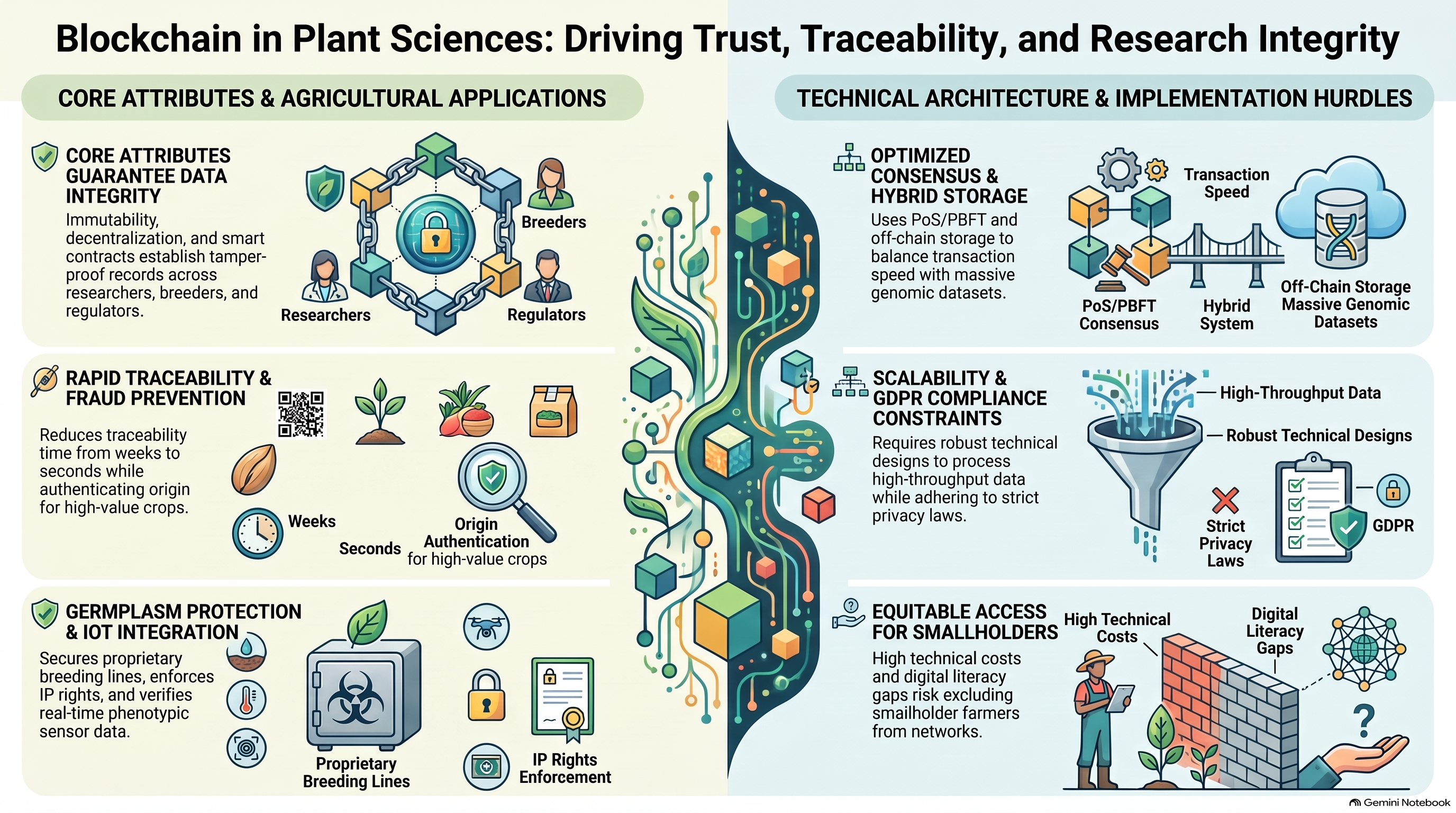
Blockchain technology has emerged as a transformative digital infrastructure capable of addressing critical challenges in plant sciences, including data integrity, traceability of high-value crops, secure germplasm authentication, and multi-stakeholder collaboration. The increasing use of genomics, phenotyping, and IoT-enabled monitoring in plant research has generated massive datasets, revealing the limitations of conventional centralized databases, such as vulnerability to tampering, restricted transparency, and single points of failure. Blockchain’s core attributes—immutability, decentralization, and cryptographic verification—offer robust solutions for maintaining trusted records across research institutions, breeding programs, supply chains, and regulatory agencies. Recent studies demonstrate that blockchain can enhance end-to-end traceability in agri-food systems, reduce fraud in high-value plant products, and improve reproducibility in plant research by time-stamping experimental data. Smart contracts allow automated enforcement of rules, such as certification of crop quality, verification of seed origin, and controlled access to research datasets. Despite these advantages, significant challenges remain, including scalability limitations, interoperability with legacy systems, energy consumption in certain consensus mechanisms, and digital literacy requirements for farmers. Comparative analyses show that blockchain’s suitability varies depending on the context, and in some cases, alternative distributed or centralized systems may offer more efficient solutions. This paper provides a comprehensive review of blockchain applications in plant sciences, integrating technical considerations, real-world case studies, ethical and regulatory aspects, and future research directions. By synthesizing current evidence, identifying research gaps, and proposing forward-looking insights, this review clarifies blockchain’s realistic potential and guides its responsible implementation in plant science research and industry.