The Remote Sensing Assessment of Vegetation Dynamics Using Sentinel-2 Indices in the Geo-Ecological Landscape of Gonabad
DOI:
https://doi.org/10.22034/JAPB.2025.168Keywords:
Arid ecosystems, Chlorophyll indices, Remote sensing, Soil salinity, Vegetation dynamicsAbstract
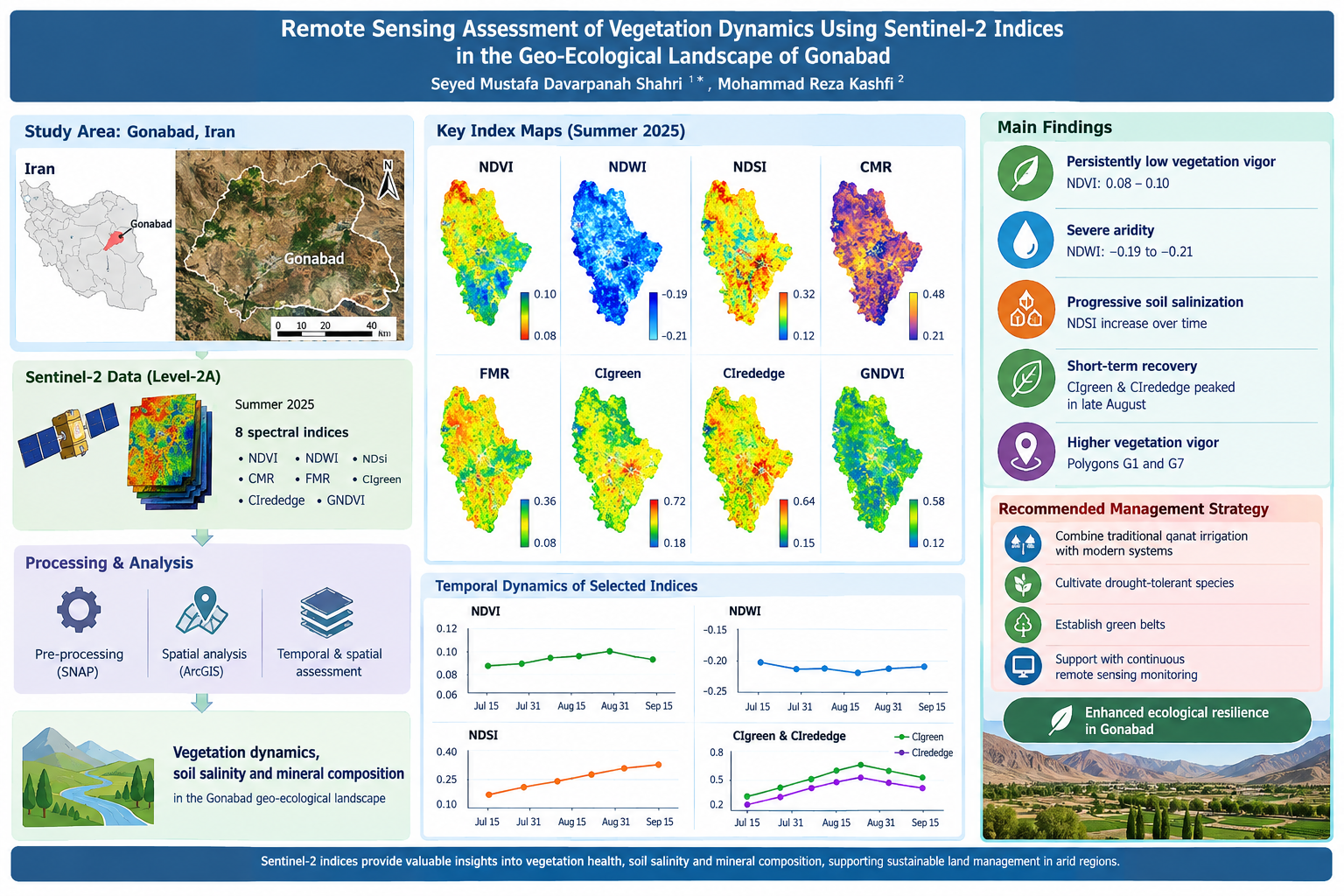
Background: Monitoring vegetation and soil conditions in arid regions is essential for understanding ecological stability and guiding sustainable land management. This study evaluates the spatial and temporal dynamics of vegetation vigor, soil salinity, and mineral composition in the Gonabad region of northeastern Iran.
Method & Material: We employed Sentinel-2 Level-2A imagery to analyze eight spectral indices during summer 2025: Normalized Difference Vegetation Index (NDVI), Normalized Difference Water Index (NDWI), Normalized Difference Salinity Index (NDSI), Clay Minerals Ratio (CMR), Ferrous Minerals Ratio (FMR), Chlorophyll Index Green (CIgreen), Chlorophyll Index Red-Edge (CIrededge), and Green Normalized Difference Vegetation Index (GNDVI). These indices captured vegetation performance, hydrological stress, and surface mineral variability.
Result: Results indicated persistently low NDVI (0.08–0.10) and negative NDWI (−0.19 to −0.21) values, consistent with severe aridity. A gradual NDSI increase reflected progressive soil salinization. Chlorophyll-sensitive indices, (CIgreen, CIrededge) peaked in late August, suggesting short-term vegetation recovery. Spatially, polygons G1 and G7 exhibited higher vegetation vigor, indicating micro-environmental resilience.
Conclusion: The integrated assessment highlights the interplay between water scarcity, salinity, and vegetation stress. We recommend a hybrid management strategy combining traditional qanat irrigation with modern systems, cultivation of drought-tolerant species, and establishing green belts. Supported by continuous monitoring, these measures can strengthen ecological resilience in Gonabad.