Novel Drug Delivery Systems for Scarless Wound Healing
DOI:
https://doi.org/10.22034/JATE.2026.222Keywords:
drug delivery, scarless, wound healing, microneedles, hydrogels, microspheres, nanofibers, exosomesAbstract
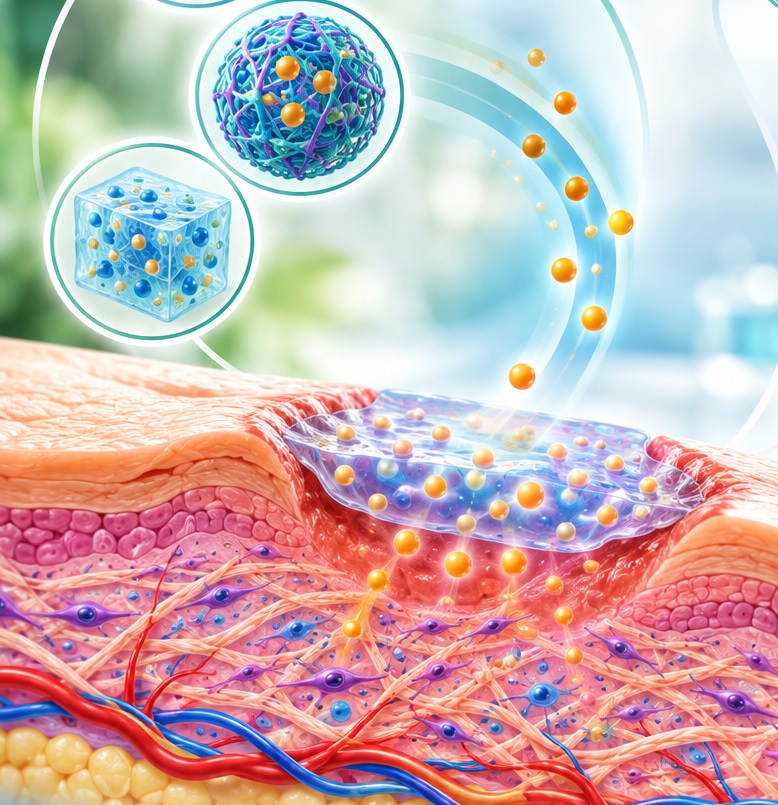
Wound healing is a complex biological process, the result of which is often pathological scarring that can have major functional and cosmetic impact. Effective scarless wound healing remains a big concern despite advances in pharmacological therapy. This study reviews the recent progress of biomaterial-based drug delivery methods for scarless wound healing. Five primary platforms are explored, including hydrogels, microspheres, nanofibers, microneedles, and exosomes. Design methodologies, modes of action, and therapeutic benefits are highlighted. However, fundamental challenges, including industrial scalability, long-term biosafety, regulatory ambiguity, and inconsistencies between animal models and human wound biology, hinder the clinical translation of these promising preclinical findings. The review closes with a potential roadmap to overcome the gap towards scarless wound healing.
References
Duan W, Xu K, Huang S, et al. Nanomaterials-Incorporated Polymeric Microneedles for Wound Healing Applications. Int J Pharm 2024;659:124247; doi: 10.1016/j.ijpharm.2024.124247.
Shi Y, Li L. Research Advances in Therapeutic Strategies and Drug Delivery Systems for Pathological Scars. Pharmaceutics 2026;18(2):1–34; doi: 10.3390/pharmaceutics18020148.
Nguyen HM, Ngoc Le TT, Nguyen AT, et al. Biomedical materials for wound dressing: recent advances and applications. RSC Adv 2023;13(8):5509–5528; doi: 10.1039/D2RA07673J.
Chai H, Wang Z, Ju J, et al. Multifunctional Hydrogel-Based Wound Dressings for Scar-Free Healing: Design Principles, Therapeutic Mechanisms, and Clinical Translation Challenges. Adv NanoBiomed Res 2026;6(1):e202500147; doi: 10.1002/anbr.202500147.
Yang W, Liu L, Cheng X. Research progress on scar-free healing. Ann Med 2025;57(1); doi: 10.1080/07853890.2025.2575109.
Javaid A, Sharma KK, Varshney P, et al. Overcoming drug delivery challenges with lipid-based nanofibers for enhanced wound repair. Biomater Sci 2025;13(8):1960–1974; doi: 10.1039/D4BM01536C.
Ma X, Bian Q, Hu J, et al. Stem from nature: Bioinspired adhesive formulations for wound healing. J Control Release 2022;345:292–305; doi: 10.1016/J.JCONREL.2022.03.027.
Fu M, Huang Z, Li J, et al. Approaching Scarless Wound Healing: From Passive Anti-Fibrotic to Proactive and Programmable Pro-Regenerative Strategies. Adv Sci 2026;13(18):e21824; doi: 10.1002/advs.202521824.
Shi Y, Guo S, Tian J, et al. Biomaterials-mediated sequential drug delivery: Emerging trends for wound healing. Asian J Pharm Sci 2025;20(6):101088; doi: 10.1016/j.ajps.2025.101088.
Zhang X, Zu Q, Deng C, et al. Biodegradable Double-Layer Hydrogels with Sequential Drug Release for Multi-Phase Collaborative Regulation in Scar-Free Wound Healing. J Funct Biomater 2025;16(5):1–20; doi: 10.3390/jfb16050164.
Li B, Li M, Wang Y. Smart Hydrogels in Wearable Electronics for Wound Treatments. Small 2025;21(45):e07368; doi: 10.1002/smll.202507368.
Hosseini SA, Noruzi S, Kesharwani P, et al. Hydrogel-based dressing for wound healing: A systematic review of clinical trials. Int J Biol Macromol 2025;308:142322; doi: 10.1016/J.IJBIOMAC.2025.142322.
Liao J, Zhou Y, Zhao X, et al. Chitin microspheres: From fabrication to applications. Carbohydr Polym 2024;329:121773; doi: 10.1016/J.CARBPOL.2023.121773.
Yang M, Shi Y, Wang F, et al. Hydrogel Microspheres as Versatile Platforms for Biomedical Research: Design, Properties, and Applications. MedComm 2025;6(10):e70423; doi: 10.1002/mco2.70423.
Boda SK, Chen S, Chu K, et al. Electrospraying Electrospun Nanofiber Segments into Injectable Microspheres for Potential Cell Delivery. ACS Appl Mater Interfaces 2018;10(30):25069–25079; doi: 10.1021/acsami.8b06386.
Park H, Patil T V., Dutta SD, et al. Extracellular Matrix-Bioinspired Anisotropic Topographical Cues of Electrospun Nanofibers: A Strategy of Wound Healing through Macrophage Polarization. Adv Healthc Mater 2024;13(12):2304114; doi: 10.1002/adhm.202304114.
Alavi SE, Alavi SZ, Nisa M un, et al. Revolutionizing Wound Healing: Exploring Scarless Solutions through Drug Delivery Innovations. Mol Pharm 2024;21(3):1056–1076; doi: 10.1021/acs.molpharmaceut.3c01072.
Liang Y, He J, Guo B. Functional Hydrogels as Wound Dressing to Enhance Wound Healing. ACS Nano 2021;15(8):12687–12722; doi: 10.1021/acsnano.1c04206.
Joshi A, Kamaraj M, Moghimi N, et al. Redefining the future of skin wound healing with modular biomaterials. Cell Biomater 2026;100381; doi: 10.1016/j.celbio.2026.100381.
Zhang X, Li Y, He D, et al. An effective strategy for preparing macroporous and self-healing bioactive hydrogels for cell delivery and wound healing. Chem Eng J 2021;425:130677; doi: 10.1016/J.CEJ.2021.130677.
Nazemoroaia M, Bagheri F, Mirahmadi-Zare SZ, et al. Asymmetric natural wound dressing based on porous chitosan-alginate hydrogel/electrospun PCL-silk sericin loaded by 10-HDA for skin wound healing: In vitro and in vivo studies. Int J Pharm 2025;668(June 2024):124976; doi: 10.1016/j.ijpharm.2024.124976.
Liu H, Wang M, Wang Q, et al. Promoting scarless wound closure utilizing an injectable thermosensitive hydrogel with anti-inflammatory, antioxidant, and scar formation inhibiting properties. Biomater Adv 2025;173(December 2024):214295; doi: 10.1016/j.bioadv.2025.214295.
Yan M, Huang S, Li X, et al. Gallic Acid Nanocrystal Hydrogel: A Novel Strategy for Promoting Wound Healing and Inhibiting Scar Formation. Int J Nanomedicine 2025;20:4607–4626; doi: 10.2147/IJN.S514961.
Pachuau L. Recent developments in novel drug delivery systems for wound healing. Expert Opin Drug Deliv 2015;12(12):1895–1909; doi: 10.1517/17425247.2015.1070143.
Luo D, Huang L, Bai B, et al. Sequential drug-release microsphere system for scarless wound healing. Mater Today Bio 2025;35(August):102310; doi: 10.1016/j.mtbio.2025.102310.
Huang C, Li Y, Liang B, et al. Gelatin-tannic acid microspheres encapsulated with amorphous selenium and zinc phosphate nanoparticles for promotion of large wound healing. Int J Biol Macromol 2026;340:149998; doi: 10.1016/j.ijbiomac.2025.149998.
Jiang J, Liang H, Ye Y, et al. Stem cell secretome armed magneto-actuated micromotors as spatio-temporal manipulators for wound healing acceleration. Nat Commun 2025;16(1):6754; doi: 10.1038/s41467-025-61914-8.
Choi JS, Kim HS, Yoo HS. Electrospinning strategies of drug-incorporated nanofibrous mats for wound recovery. Drug Deliv Transl Res 2013 52 2013;5(2):137–145; doi: 10.1007/S13346-013-0148-9.
Rieger KA, Birch NP, Schiffman JD. Designing Electrospun Nanofiber Mats to Promote Wound Healing-a Review. J Mater Chem B 2013;1(36):4531–4541; doi: 10.1039/c3tb20795a.
Chen J, Zhou L, Hang Z, et al. Electrospun Biomaterials for Scarless Acne Wound Healing: Advances and Prospects. J Funct Biomater 2025;16(9):316; doi: 10.3390/jfb16090316.
Nie W, Marrotte EJ, Xie R, et al. Towards scarless repair: MMP-2 responsive drug releasing nanofibrous mat restores homeostasis via fibroblasts’ activation. Compos Part B Eng 2025;291(June 2024):111972; doi: 10.1016/j.compositesb.2024.111972.
Cao J, Wu B, Yuan P, et al. Advances in Research of Hydrogel Microneedle-Based Delivery Systems for Disease Treatment. Pharmaceutics 2024;16(12):1571; doi: 10.3390/pharmaceutics16121571.
Kumar D, Pandey S, Shiekmydeen J, et al. Therapeutic Potential of Microneedle Assisted Drug Delivery for Wound Healing: Current State of the Art, Challenges, and Future Perspective. AAPS PharmSciTech 2025;26(1):1–29; doi: 10.1208/s12249-024-03017-z.
Wang Y, He Y, Zhang T, et al. Advances in microneedle technology for skin wound healing: integrating nanomaterials and intelligent drug delivery systems. Nanoscale 2025;17(32):18505–18533; doi: 10.1039/d5nr01953b.
Yang X, Cao W, Gu X, et al. Simvastatin nanocrystals-based dissolving microneedles for wound healing. Int J Pharm 2023;647:123543; doi: 10.1016/J.IJPHARM.2023.123543.
Zhang Y, Wang S, Yang Y, et al. Scarless wound healing programmed by core-shell microneedles. Nat Commun 2023;14(1):3431; doi: 10.1038/s41467-023-39129-6.
Wei C, You C, Zhou L, et al. Antimicrobial hydrogel microneedle loading verteporfin promotes skin regeneration by blocking mechanotransduction signaling. Chem Eng J 2023;472:144866; doi: 10.1016/J.CEJ.2023.144866.
Liao Z, Chen X, Hirt-Burri N, et al. Pharmacological and Biological Strategies as Regulators of Scarless Wound Healing and Regeneration of Skin. Wound Heal - Mech Pharmacol Interv 2025; doi: 10.5772/intechopen.1012960.
Wang X, Xu Z, Lv Y, et al. Mesenchymal Stem Cells-Derived Exosomes: Next-Generation Nanomedicines Toward Scarless Wound Healing. Int J Nanomedicine 2026;21; doi: 10.2147/IJN.S586955.
Kang Y, Yang Y, Yao B, et al. Scar Inhibition in Wound Healing: Mechanisms, Design, and Recent Advances. Exploration 2026;1–26; doi: 10.1002/EXP.20240517.
Wgealla MM arak MA, Liang H, Chen R, et al. Amniotic fluid derived stem cells promote skin regeneration and alleviate scar formation through exosomal miRNA-146a-5p via targeting CXCR4. J Cosmet Dermatol 2022;21(10):5026–5036; doi: 10.1111/JOCD.14956.
Lim DZJ, Chun YY, Tan FNSY, et al. Small interfering RNA microneedle patches versus silicone sheets in reducing postoperative scars: a randomized single-blinded intraindividually controlled clinical trial. Br J Dermatol 2024;192(1):19–26; doi: 10.1093/BJD/LJAE347.
Moore LE, Vucen S, Moore AC. Trends in drug- and vaccine-based dissolvable microneedle materials and methods of fabrication. Eur J Pharm Biopharm 2022;173:54–72; doi: 10.1016/J.EJPB.2022.02.013.
Concha VOC, Bahú JO, Crivellin S, et al. Harnessing electrospinning for improvement of polymeric drug delivery systems. Polym Bull 2025;82(11):5909–5943; doi: 10.1007/s00289-025-05710-w.
Catoira MC, González-Payo J, Fusaro L, et al. Natural hydrogels R&D process: technical and regulatory aspects for industrial implementation. J Mater Sci Mater Med 2020;31(8):64; doi: 10.1007/s10856-020-06401-w.
Luo Y, Wang M, Wan C, et al. Devising Materials Manufacturing Toward Lab-to-Fab Translation of Flexible Electronics. Adv Mater 2020;32(37):2001903; doi: 10.1002/ADMA.202001903.
Mierzejewska ŻA, Veselinović V, Trtić N, et al. Advanced Biomaterials for Craniofacial Tissue Regeneration: From Fundamental Mechanism to Translational Applications—A Scoping Review. J Funct Biomater 2026;17(1):44; doi: 10.3390/jfb17010044.
Mohammadpour R, Cheney DL, Grunberger JW, et al. One-year chronic toxicity evaluation of single dose intravenously administered silica nanoparticles in mice and their Ex vivo human hemocompatibility. J Control Release 2020;324:471–481; doi: 10.1016/J.JCONREL.2020.05.027.
Liu Y, Wang K, Gao F, et al. Micro/Nanorobots in Wound Healing: Bridging the Gap from Concept to Clinical Translation. Int J Nanomedicine 2025;20:15343–15362; doi: 10.2147/IJN.S557042.
Chakrapani G, Vijay Kumar V, Zare M. Next-Generation Biomaterials: Design Strategies, Clinical Translation, and the Rise of Intelligent Therapeutic Platforms. ACS Omega 2025;10(40):46272–46293; doi: 10.1021/ACSOMEGA.5C06034.
Mohammadi N, Narayan M. Nanomaterials for controlled drug delivery in wound healing: Recent advances and future directions. Curr Opin Biomed Eng 2026;37:100637; doi: 10.1016/J.COBME.2025.100637.
Yang C, Zhang L, Zhou A, et al. Cryomicroneedle Arrays for Biotherapeutics Delivery. Small Sci 2025;5(8); doi: 10.1002/SMSC.202500009.
Rafati F, Ghorbani Z, Manoochehrabadi T, et al. Smart integrated biomaterial systems for precision and optimized delivery of MSCs and their exosomes: Transforming wound healing and organ regeneration. Regen Ther 2026;31:101045; doi: 10.1016/J.RETH.2025.101045.
Prakoeswa FRS, Dzikri DN. Scarless Wound Healing: Recent Advances and Innovations. Cermin Dunia Kedokt 2025;52(8):546–552; doi: 10.55175/CDK.V52I8.1678.
Chakrabarti S, Ahmed RK, Nath S, et al. Scar-free wound healing: Advances in biomaterial-based formulations, smart dressings and bioactive therapeutics – a comprehensive review. Biochem Biophys Res Commun 2026;820:153839; doi: 10.1016/J.BBRC.2026.153839.
Downloads
Published
How to Cite
Issue
Section
License
Copyright (c) 2026 The Journal of Applied Tissue Engineering

This work is licensed under a Creative Commons Attribution-NonCommercial-NoDerivatives 4.0 International License.