Genetic & epigenetic regulation of scar formation
DOI:
https://doi.org/10.22034/JATE.2026.220Keywords:
DNA Methylation, Epigenetic Regulation, , Non-coding RNAs, Pathological ScarringAbstract
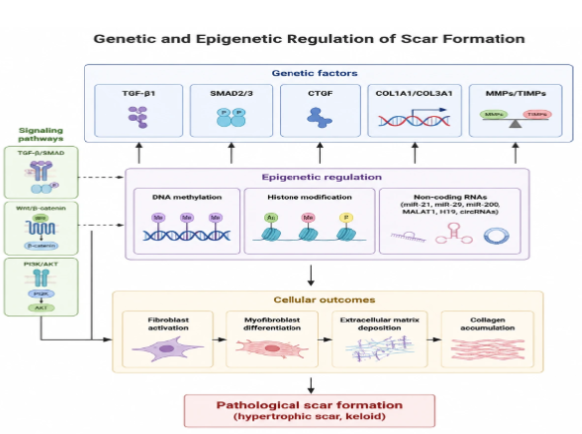
Within the scope of this review, the roles of epigenetic alterations and genetics in scar formation are investigated. The speed and quality of scar formation are influenced by epigenetic mechanisms such as DNA methylation, histone changes, regulation by non-coding RNAs (ncRNAs), and RNA methylation. These mechanisms regulate gene expression, cell function, and intercellular signaling, which in turn affects scar formation. DNA, which is packaged into chromatin, encodes the genetic information contained within a cell. Additionally, epigenetic changes of DNA and histones, which are the fundamental constituents of chromatin, constitute an extra layer of information that has an effect on the expression of the genes that lie under the surface. In those who are genetically predisposed to the condition, it appears that the environment is the cause of the disease. Some genes have been suggested as potential contributors to the etiology of scarring; however, no single gene mutation has been identified as the cause of scarring as of yet. Therefore, in order to determine the etiology of scarring, it is recommended that a mix of techniques, including association, gene-gene interaction, epigenetics, linkage, gene expression, and protein analysis, be utilized.
References
Kang Y, Yang Y, Yao B, Zhang Z, Ji X, editors. Scar inhibition in wound healing: Mechanisms, design, and recent advances. Exploration; 2026: Wiley Online Library.
Zhou F, Zeng G. Decoding the Causal Effects of Blood-Related Phenotypes in Hypertrophic Scars and Keloids: A Mendelian Randomization Study. Clinical, Cosmetic and Investigational Dermatology. 2026:593178.
Grinis D, Thomas M, Aprigliano C, Maskey AR. Refractory Keloids and Hypertrophic Scars: Immune Dysregulation and Neuroimmune Mechanisms Underlying Treatment Failure. Cells. 2026;15(9):782.
Thomas A, Farah K, Millis RM, Millis R. Epigenetic influences on wound healing and hypertrophic-keloid scarring: a review for basic scientists and clinicians. Cureus. 2022;14(3).
Khaghani F, Hamzehloei T. The interplay of genetic background, epigenetics, and behavior: perspectives on the Iranian population. Egyptian Journal of Medical Human Genetics. 2026;27(1):52.
Llanos-Rodríguez JF, Malvaez ADDLF, Jiménez-Osorio AS, López-Hernández LB, Solares-Tlapechco J, Marín G, et al. Genomic and Epigenetic Landscapes of Keloid Scarring: Ancestry–Dependent Insights and Therapeutic Implications—A Narrative Review. Cosmetics. 2026;13(2):70.
Brown J, Bayat A. Genetic susceptibility to raised dermal scarring. British Journal of Dermatology. 2009;161(1):8–18.
Marneros AG, Norris JE, Watanabe S, Reichenberger E, Olsen BR. Genome scans provide evidence for keloid susceptibility loci on chromosomes 2q23 and 7p11. Journal of Investigative Dermatology. 2004;122(5):1126–32.
Mueller SM, Miller N, Gill J, Yu LC, Pike MD, Orgill DP. Genetic Determinants of Wound Healing: Monogenic Disorders and Polygenic Influence. Cells. 2026;15(1):74.
Halim AS, Emami A, Salahshourifar I, Kannan TP. Keloid scarring: understanding the genetic basis, advances, and prospects. Archives of plastic surgery. 2012;39(03):184–9.
Shih B, Bayat A. Genetics of keloid scarring. Archives of dermatological research. 2010;302(5):319–39.
Dand N, Ung CY, Saklatvala JR, Simpson MA, Barker JN, Shaw TJ, et al. GWAS meta-analysis identifies susceptibility loci for keloids and hypertrophic scarring in europeans. Journal of Investigative Dermatology. 2025;145(6):1538–40. e8.
Sood RF, Hocking AM, Muffley LA, Ga M, Honari S, Reiner AP, et al. Genome-wide association study of postburn scarring identifies a novel protective variant. Annals of surgery. 2015;262(4):563–9.
Edvardsen H, Landmark-Høyvik H, Reinertsen KV, Zhao X, Grenaker-Alnæs GI, Nebdal D, et al. SNP in TXNRD2 associated with radiation-induced fibrosis: a study of genetic variation in reactive oxygen species metabolism and signaling. International Journal of Radiation Oncology* Biology* Physics. 2013;86(4):791–9.
Ung CY. Genetics of Scarring: King's College London; 2023.
Lewis CJ, Stevenson A, Fear MW, Wood FM. A review of epigenetic regulation in wound healing: Implications for the future of wound care. Wound Repair and Regeneration. 2020;28(6):710–8.
Law JA, Jacobsen SE. Establishing, maintaining and modifying DNA methylation patterns in plants and animals. Nature Reviews Genetics. 2010;11(3):204–20.
Neary R, Watson CJ, Baugh JA. Epigenetics and the overhealing wound: the role of DNA methylation in fibrosis. Fibrogenesis & tissue repair. 2015;8(1):18.
Sun X, He Y, Huang C, Ma T-T, Li J. The epigenetic feedback loop between DNA methylation and microRNAs in fibrotic disease with an emphasis on DNA methyltransferases. Cellular signalling. 2013;25(9):1870–6.
Su Y, Li W, Lv Q, Su R. Histone Modifications: Decoding the Epigenetic Basis of Economic Traits in Livestock and Poultry. Genes. 2026;17(5):571.
Hu Y, He Z, Li Z, Wang Y, Wu N, Sun H, et al. Lactylation: the novel histone modification influence on gene expression, protein function, and disease. Clinical epigenetics. 2024;16(1):72.
Liu Z, Chen O, Zheng M, Wang L, Zhou Y, Yin C, et al. Re-patterning of H3K27me3, H3K4me3 and DNA methylation during fibroblast conversion into induced cardiomyocytes. Stem cell research. 2016;16(2):507–18.
Beacon TH, Delcuve GP, López C, Nardocci G, Kovalchuk I, Van Wijnen AJ, et al. The dynamic broad epigenetic (H3K4me3, H3K27ac) domain as a mark of essential genes. Clinical epigenetics. 2021;13(1):138.
Plewa P, Figiel K, Ćmil M, Skórka P, Kupis K, Pawlik A. The Role of Non-Coding RNA in the Pathogenesis of Hypertensive Nephropathy. Cells. 2026;15(8):701.
Yang L, Lv Y. Noncoding RNAs in chronic wound healing: Mechanisms, exosome therapeutics, and translational frontiers. Journal of Tissue Engineering. 2026;17:20417314251410000.
Korytina GF, Markelov VA, Gibadullin IA, Zulkarneev SR, Nasibullin TR, Zulkarneev RH, et al. The Relationship Between Differential Expression of Non-Coding RNAs (TP53TG1, LINC00342, MALAT1, DNM3OS, miR-126-3p, miR-200a-3p, miR-18a-5p) and Protein-Coding Genes (PTEN, FOXO3) and Risk of Idiopathic Pulmonary Fibrosis. Biochemical genetics. 2026;64(1):345–85.
Geara J. Modulating fibroblasts in hard-to-heal wounds and skin ageing: roles of circRNAs and dermal injectables: Karolinska Institutet; 2026.
Wu Y-L, Lin Z-J, Li C-C, Lin X, Shan S-K, Guo B, et al. Epigenetic regulation in metabolic diseases: mechanisms and advances in clinical study. Signal Transduction and Targeted Therapy. 2023;8(1):98.
Izamin I, Bakar LA, Reduan MFH, Wakil AM, Noordin N. Single nucleotide polymorphism markers and their applications for cattle production in selective breeding: A review for meat production traits: https://doi. org/10.12982/VIS. 2026.020. Veterinary Integrative Sciences. 2026;24(1):1–12.
Li J, Liu W, Yang J, Li Y. Epigenetic orchestration of scar formation: Therapeutic potential of targeting DNA methylation and non‑coding RNAs in cutaneous fibrosis. Molecular Medicine Reports. 2026;34(1):1–17.
Zhou S, Wang L, Chen N, Liu J, Zhang R, Zhou S, et al. Advances in the interplay between mechanical forces and inflammatory immunity in keloid formation. Frontiers in Immunology. 2026;17:1792028.
Cheng J, Qian W, Chen F, Liu X, Fu M, Cao W, et al. Function of epigenetic modifications in wound healing and potential therapies. International Journal of Molecular Medicine. 2025;56(5):190.
Kong H, Li J, Lou J, Zhang Y, Li M, Chen Y, et al. Deciphering miRNA-mediated genetic architecture of immune cell subsets in hypertrophic scars and keloids: A 2-step Mendelian randomization study unveiling causal associations. Medicine. 2026;105(6):e46429.
Lv Y, Li M, Ji C. Advances and challenges of precision epigenetic therapy in treating genomic imprinting diseases. Translational Pediatrics. 2026;15(1):19.
Bulygin AA, Davletgildeeva AT, Kuznetsov NA. Recent Advances in Searching for DNMT Inhibitors and Their Potential Application in Treating Human Diseases. International Journal of Molecular Sciences. 2026;27(10):4560.
Ziabska K, Pawelec P, Stanaszek L, Ziemka-Nalecz M. The Diverse Effect of HDAC Inhibitors: Sodium Butyrate and Givinostat on Microglia Polarization After Hypoxia-Ischemia In Vitro. International Journal of Molecular Sciences. 2026;27(2):1114.
Schäker-Hübner L, Hansen FK. Recommended Tool Compounds: Isoform-and Class-Specific Histone Deacetylase Inhibitors. ACS Pharmacology & Translational Science. 2026;9(3):462–89.
Jeena T, Rakshitha C, Jain AB, Razana F, Varughese A, Muneesa MF, et al. Therapeutic Potential of Lentiviral miR‐200a Mimics in Regulating Fibrinolysis and EMT Markers During Pulmonary Fibrosis. FASEB BioAdvances. 2026;8(4):e70096.
Gong J, Xu J, Zhang J, Shen Y, Sun H, Chen B. Molecular mechanisms of skeletal muscle fibrosis and potential targeted therapeutic strategies. Frontiers in Immunology. 2026;17:1714238.
Chai H, Wang Z, Ju J, Sun J. Multifunctional hydrogel‐based wound dressings for scar‐free healing: Design principles, therapeutic mechanisms, and clinical translation challenges. Advanced NanoBiomed Research. 2026;6(1):e202500147.
Amjadian S, Moradi S, Mohammadi P. The emerging therapeutic targets for scar management: genetic and epigenetic landscapes. Skin Pharmacology and Physiology. 2022;35(5):247–65.
Downloads
Published
How to Cite
Issue
Section
License
Copyright (c) 2026 The Journal of Applied Tissue Engineering

This work is licensed under a Creative Commons Attribution-NonCommercial-NoDerivatives 4.0 International License.