Magnetically Responsive TPMS-Based Smart Scaffold for Bone Tissue Engineering: Numerical Investigation Using COMSOL Multiphysics
DOI:
https://doi.org/10.22034/JATE.2026.212Keywords:
Smart Scaffold, Magnetic Field Stimulation, COMSOL Multiphysics, Bone Regeneration, TPMS StructureAbstract
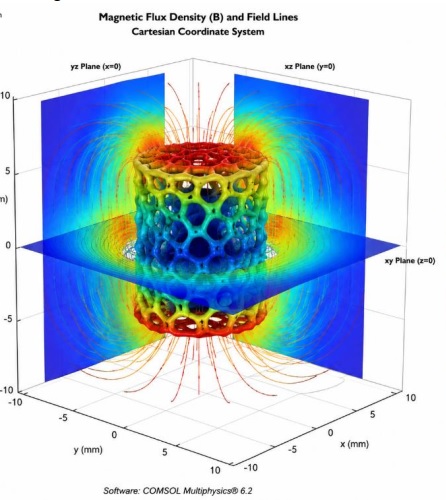
Magnetically responsive scaffolds have emerged as promising platforms in tissue engineering due to their ability to provide remote, non-invasive stimulation for regulating cellular behavior and enhancing tissue regeneration. In this study, a novel triply periodic minimal surface (TPMS)-based smart scaffold reinforced with superparamagnetic iron oxide nanoparticles (SPIONs) was designed and numerically investigated using COMSOL Multiphysics®. The scaffold architecture was optimized to combine high porosity, interconnected pore networks, and magnetic responsiveness for bone tissue engineering applications. A three-dimensional finite element model was developed to analyze magnetic flux density distribution, field intensity, and magnetic field propagation under an external static magnetic field. Simulations were performed using Cartesian, cylindrical, and spherical coordinate systems to comprehensively evaluate magnetic behavior within and around the scaffold structure. The results demonstrated homogeneous magnetic field penetration throughout the porous architecture, with localized magnetic flux enhancement observed at pore-wall intersections and regions of high curvature. The maximum magnetic flux density reached approximately 2.08 mT, which lies within the biologically effective range reported for osteogenic stimulation. The proposed scaffold generated controllable magnetic microenvironments capable of enhancing mechanotransduction pathways, promoting cell proliferation, and supporting bone regeneration. The findings suggest that TPMS-based magnetic scaffolds represent a promising strategy for next-generation smart biomaterials and magnetically controlled regenerative therapies.
References
- Araya, M., Jaskari, M., Rautio, T., Guillén, T., & Järvenpää, A. (2024). Assessing the compressive and tensile properties of TPMS-Gyroid and stochastic Ti64 lattice structures: A study on laser powder bed fusion manufacturing for biomedical implants. Journal of Science: Advanced Materials and Devices, 9(1), 100663. Doi:https://doi.org/10.1016/j.jsamd.2023.100663
- do Espirito Santo, G., de Souza, A., Amaral, G. O., Alqualo, A. S., Sousa, K. d. S. J., Viegas, B. L. M., Prado, J. P. d. S., Dos Santos, F. V., Correa, D. S., & Granito, R. N. (2025). Development and Comparison of Two 3D-Printed Scaffolds of Biosilica from Marine Sponges for Bone Tissue Engineering. ACS omega, 10(20), 20257-20267. Doi:https://doi.org/10.1021/acsomega.4c11383
- Lodi, M. B., Fanti, A., Vargiu, A., Bozzi, M., & Mazzarella, G. (2021). A multiphysics model for bone repair using magnetic scaffolds for targeted drug delivery. IEEE Journal on Multiscale and Multiphysics Computational Techniques, 6, 201-213. Doi:https://doi.org/10.1109/JMMCT.2021.3134786
- Nayak, M. R., Bayannavar, P. K., & Kamble, R. R. (2024). Design of Medicinally Pertinent Multifunctional Inorganic Nanomaterials Using Artificial Intelligence. In Multifunctional Inorganic Nanomaterials for Energy Applications (pp. 395-412). CRC Press.
- O'brien, F. J. (2011). Biomaterials & scaffolds for tissue engineering. Materials today, 14(3), 88-95. Doi:https://doi.org/10.1016/S1369-7021(11)70058-X
- Saikia, N. (2024). Inorganic-based nanoparticles and biomaterials as biocompatible scaffolds for regenerative medicine and tissue engineering: Current advances and trends of development. Inorganics, 12(11), 292. Doi:https://doi.org/10.3390/inorganics12110292
- Santo, V. E., Gomes, M. E., Mano, J. F., & Reis, R. L. (2013). Controlled release strategies for bone, cartilage, and osteochondral engineering—part I: recapitulation of native tissue healing and variables for the design of delivery systems. Tissue Engineering Part B: Reviews, 19(4), 308-326. Doi:https://doi.org/10.1089/ten.teb.2012.0138
- Wang, Q., Chen, B., Cao, M., Sun, J., Wu, H., Zhao, P., Xing, J., Yang, Y., Zhang, X., & Ji, M. (2016). Response of MAPK pathway to iron oxide nanoparticles in vitro treatment promotes osteogenic differentiation of hBMSCs. Biomaterials, 86, 11-20. Doi:https://doi.org/10.1016/j.biomaterials.2016.02.004
- Yang, J., Wu, J., Guo, Z., Zhang, G., & Zhang, H. (2022). Iron oxide nanoparticles combined with static magnetic fields in bone remodeling. Cells, 11(20), 3298. Doi:https://doi.org/10.3390/cells11203298
- Yun, H.-M., Ahn, S.-J., Park, K.-R., Kim, M.-J., Kim, J.-J., Jin, G.-Z., Kim, H.-W., & Kim, E.-C. (2016). Magnetic nanocomposite scaffolds combined with static magnetic field in the stimulation of osteoblastic differentiation and bone formation. Biomaterials, 85, 88-98. Doi:https://doi.org/10.1016/j.biomaterials.2016.01.035
Downloads
Published
How to Cite
Issue
Section
License
Copyright (c) 2026 The Journal of Applied Tissue Engineering

This work is licensed under a Creative Commons Attribution-NonCommercial-NoDerivatives 4.0 International License.